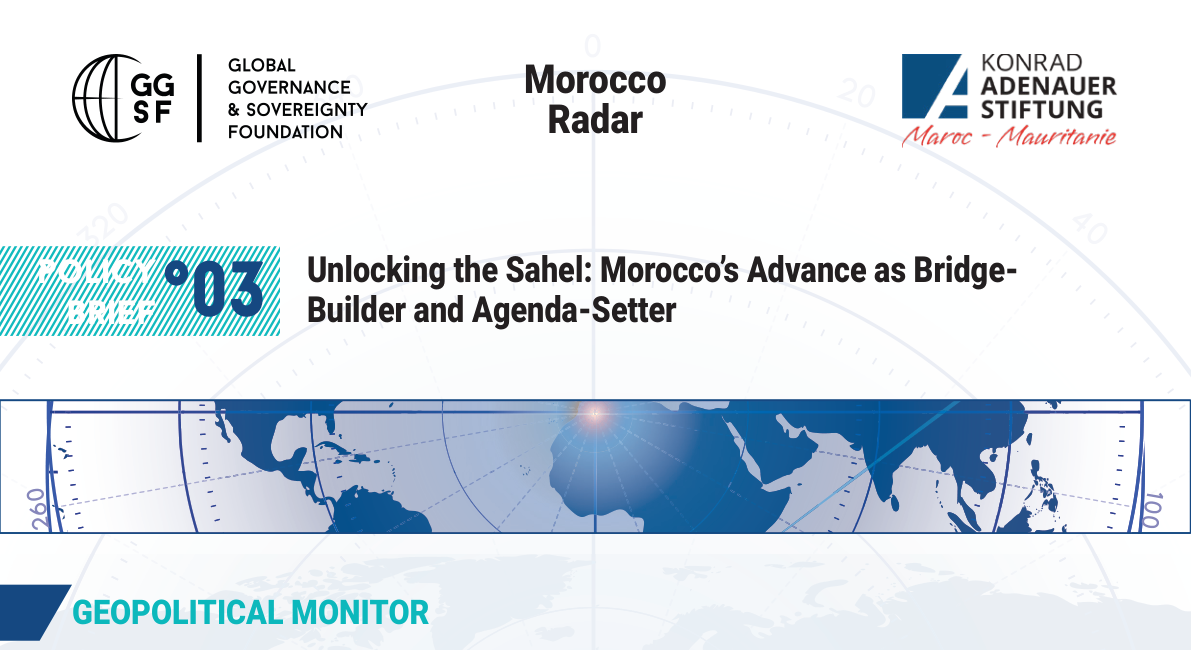
In April 2025, King Mohammed VI received the foreign ministers of the Alliance of Sahel States under the Royal Initiative for Sahel Access. GGSF Policy Brief N°03 reads that opening as the core of a Morocco Sahel strategy built on diplomacy and connectivity rather than coercion.
What follows are the brief’s key takeaways. The full analysis — the options, the points of vigilance and the recommendations — is in the document.
Key takeaways on Morocco Sahel strategy
- Rabat convened the Sahel’s new gatekeepers. The April 2025 meeting with the AES foreign ministers builds on Morocco’s 2017 return to the African Union, $1.2 billion in trade with the Sahel, and imams trained in Rabat since 2015.
- The vacuum is real. France’s withdrawal from Burkina Faso, Mali and Niger in 2023–2024 left a space exploited by JNIM, whose attacks doubled in Mali’s Mopti region in 2024, against 8,000 deaths that year.
- Others reached the security file first. Russia deployed an estimated 1,500 Africa Corps “security advisors” to Mali in 2024 and secured a potential $500 million uranium deal in Niger via Rosatom. Turkey supplies Bayraktar TB2 drones to Mali and Niger.
- Algeria’s waning influence opens room. The downing of a Malian drone in April 2025 and Mali’s accusations against Algiers have weakened its standing, while Morocco’s mediation in Libya and the Marrakech conference of 2023 show the capacity Rabat can trade on.
- Connectivity is the working lever. The African Atlantic Initiative unites 23 Atlantic states, and the Sahel Access Initiative of November 2023 opens Moroccan ports such as Dakhla to landlocked states. Royal Air Maroc is the sole air link to Europe.
- The gas pipeline is both flagship and exposure. The $25 billion Morocco-Nigeria pipeline would run 6,000 kilometres across 13 states, carrying 15–30 billion cubic metres a year, with a first section operational by 2029. Its success hinges on Mauritania.
- Energy, food and security cooperation carry the strategy. The brief weighs a Sahel where 70% of the population lacks reliable electricity and 20 million face food insecurity against Morocco’s 2,000 MW Noor solar complex, its fertilisers and its troop training.
- Watch the financing and the perception. Jihadist attacks rose 20% in 2024, transport costs absorb 30–40% of Sahel import values, and the pipeline needs sustained investment across 13 countries. Rabat must keep the initiative reading as genuinely African-led.
What to hold in view
The exposure lies less in the projects than in who is seen to own them. Sahel military governments that quit ECOWAS in 2024 read external designs as “neocolonial”, while Western pressure over Morocco’s Russian trade and Algeria’s backing for the Polisario Front narrow the margin. The brief’s answer is hybrid: country-to-country ties, wider regional frameworks and practical cooperation.